November 27, 2013

HCV Infected Prisoners

BMC Infectious Diseases

Should They Be Still Considered a Difficult to Treat Population?

Fabio Iacomi, Giuseppina Iannicelli, Andrea Franceschini, Paolo Migliorisi, Silvia Rosati, Pierluca Piselli, Paola Scognamiglio, Gabriella De Carli, Sonia Marcellini, Fabrizio Palmieri

BMC Infect Dis. 2013;13(374)

Abstract

Background: The prevalence of chronic hepatitis C virus (HCV) infection in the Italian correctional population is estimated to be around 38%. In this setting HCV infection treatment is controversial because of several factors such as active drug substance abuse, psychiatric illness, length of treatment, risk of re-infection, poor adherence and low success rate.

Methods: A retrospective data review of 159 inmates, positive for anti-Hepatitis C virus (HCV) antibody, evaluated to National Institute for Infectious Diseases "L. Spallanzani" (INMI) from January 2006 to December 2009, was conducted to evaluate rate of completion (feasibility) and outcome efficacy of chronic Hepatitis C Virus (HCV) infection treatment with Pegylated Interferon and Ribavirin in five correctional facilities in Rome.

Results: Of the 159 inmates evaluated in the study period, 50, all male (median age 39 years) were treated. Twenty patients (40%) did not complete treatment: 15 showed no response and therapy was stopped, 5 patients (10%) interrupted treatment because of adverse reactions. The global feasibility was 60%. The overall sustained virologic response (SVR) was 50% (32% for genotype 1 and 68% for genotype other than 1). The main predictors of SVR at the Multivariable Logistic Regression Odds Ratio (MLR-OR) were a better pretreatment histological diagnosis (absence of bridging fibrosis or cirrhosis [MLR-OR 11.85; 95% CI 1.96–71.62) and a HCV genotype other than 1 (MLR-OR 5.87; 95% CI 1.49–23.17).

Conclusions: Chronic HCV infection treatment in correctional facilities is feasible and effective and should be strongly recommended, in combination with preventive measures, in appropriately screened patients because it represents an important opportunity to treat a population with a high prevalence of chronic HCV infection among whom treatment options post incarceration may be limited.

Background

In Italy the estimated prevalence of anti-Hepatitis C virus (HCV) antibody seropositivity in the general population is 2,9%,with a north–south gradient and increasing with age.[1,2] Rates are considerably higher in the Italian correctional population (38%) because of the higher proportion of intravenous drug users (IVDUs).[3]

Despite the relatively high success rates reported in the U.S. and Canada correctional population,[4–9] several factors reported as potential obstacles to treatment of chronic HCV infection in the general population, such as active drug substance abuse, psychiatric illness, length of treatment, risk of re-infection, poor adherence and low success rates, may be more prevalent in this setting.[5,8,10]

Many accurate data are published on the prevalence of HCV infection in the correctional population in Europe,[2,11,12] but in the same population few data are available on the outcome of treatment of chronic HCV infection.[12,13]

To evaluate feasibility and efficacy of treatment of chronic HCV infection in this setting, a retrospective review of medical records was performed in a cohort of inmates in five correctional facilities in Rome.

Methods

Patients

Were retrospectively evaluated data of 159 inmates (148 males, 11 females) who tested positive for anti-HCV antibody (HCV-Ab) at their entry in five correctional facilities in Rome (Casa Circondariale(CC) Regina Coeli, and Istituti Penitenziari Rebibbia, which include: CC Nuovo Complesso, CC Femminile, Casa di Reclusione, III Casa, Casa di Reclusione; average daily census 2541 in the study period) and were sent for consultation at the National Institute for Infectious Diseases "L. Spallanzani" (INMI), Rome, from January 2006 to December 2009.

All inmates were tested for HCV-Ab, HCV viremia (HCV-RNA), human immudeficiency virus antibodies (HIV-Ab) and hepatitis B surface antigen (HBsAg). Serologic tests were performed using microparticle enzyme immunoassays (EIAs) for HBsAg (AxSYM, Abbott, Wiesbaden, Germany), HCV 3.0 third-generation EIAs (Abbott) for HCV-Ab and the Genscreen HIV 1/2 ELISA (BioRad, Marnes La Coquette, France) for HIV-Ab. HCV-RNA was measured using the COBAS Taq-Man HCV test (Roche Molecular System) with a detection limit of 12 IU/ml. If patients had HCV-RNA detectable in serum, HCV genotype was determined using the reverse hybridization method (InnoLipa HCV II; Siemens Medical Solutions Diagnostics, Tarrytown, NY), those with an expected length of stay in the correctional facility of less than 12 (for genotypes 2, 3) or 18 (for genotypes 1, 4) months necessary for evaluation, uninterrupted treatment and follow-up were not considered eligible for treatment. The remaining population underwent clinical and laboratory evaluation to assess contraindications to treatment with interferon and ribavirin, including psychiatric consultation and screening for drugs or alcohol abuse: patients were considered eligible for immediate treatment if they were on rehabilitation or stable maintenance agonist therapy (methadone) according recommendations of Italian Association for the Study of the Liver (A.I.S.F.), Italian Society of Infectious and Tropical Diseases (S.I.M.I.T.), Italian Federation Department's Operators and Addiction Services (FederSerD), Italian Prison Medicine and Healthcare Society (S.I.M.S.Pe).[14,15]

For the many inmates who were in the process of being transferred to other correctional facilities depending for health assistance from other institutions outside Rome, or were going to be released and living outside our area, initiation of treatment was deferred and they were referred for treatment and clinical and virological follow-up to other healthcare facilities in the place of final residence.

Information on length of incarceration was available on clinical charts only as categorical variable: for genotypes 1 and 4 < or > of 18 months; for the other genotypes < or> of 12 months.

Figure 1 shows the decisional algorithm for eligibility to treatment.

813105-fig1

Figure 1. Algorithm for evaluation of patients eligible to the treatment.

Patients were offered treatment if they had undergone a liver biopsy at INMI that was consistent with chronic hepatitis and had been categorized as F1 to F4 according to METAVIR system for fibrosis staging.[16]

Standard guidelines for treatment of chronic HCV infection, available at the time of patient's evaluation, were followed.[17]Genotypes 1 and 4 were treated for 48 weeks with Pegylated Interferon-α2a, 180 μcg subcutaneously once a week, in combination with Ribavirin 15 mg/kg/day. Genotypes 2 and 3 were treated for 24 weeks with Pegylated Interferon-α2a, 180 μg subcutaneously once a week in combination with Ribavirin 800 mg/day.

Pegylated Interferon-α2a was administered by directly observed therapy (DOT) while Ribavirin was self administered.

Side effects were regularly monitored and therapy was modified or stopped according to standard guidelines.

In accordance with provisions of the regulatory authority "Agenzia Italiana del Farmaco" (A.I.F.A.) in force at 2008, when we had conducted this study, the approval of the Ethics Committee was not required for retrospective observational studies.[18]

Data Analysis

The measure of feasibility was the rate of treatment completion. The measure of efficacy was the rate of sustained virologic response (SVR), defined as undetectable HCV-RNA in serum at the end of follow-up, 24 weeks after treatment withdrawal. The whole treated population - i.e. all patients who received at least one dose of study medication- was included in the analysis (intention to treat analysis).

Association between SVR and selected patients' characteristics was assessed by means of Odds Ratios (ORs) and their 95% Confidence Intervals (95% CI) in order to define predictors of SVR in the study population using Logistic Regression.

χ2 test (or Fisher's exact test when applicable) or Mann Whitney non-parametric test were used to compare groups for categorical or continuous variables, respectively.

Univariable analysis was conducted to select significant variables (p<0.10) to be included in the multivariable analysis, in which Multivariable Logistic Regression Odds ratio (MLR-OR) was calculated. Were considered two different models: Model I in which all selected variables were included, and Model II in which the final model included only those variables selected after a backward elimination (p<0.10) of those variables included in Model I.

Statistical analysis was performed using SPSS ver. 19 (SPSS Inc).

Results and Discussion

Continue reading full article here …..

Chance of approval for Enanta's hep C drug increases with recent data

Nov 27, 2013, 1:05pm EST

Don Seiffert
BioFlash Editor-Boston Business Journal
Email

Jay_Luly_Enanta_HIRES-304

Jay Luly, CEO of Enanta Pharmaceuticals, called 2013 a "transformational year."

In its first full-year financial report since becoming a publicly-traded biotech, Enanta Pharmaceuticals reported a smaller loss than expected, and one analyst is raising his estimated chance of success of its drug for hepatitis C.

The Watertown biotech, which raised $64 million (minus fees and other expenses) in its initial public offering in March, reported a net income of $9.6 million for the full year that ended in September, with revenue of $32 million compared to $42 million for the previous year. Adjusted to exclude one-time costs and other expenses, the company had an adjusted net loss per share of 67 cents a share – down from a profit of $1.13 in 2012, but beating the $1.78 consensus that three analysts were expecting for the full year.

The company also said it had $112.2 million in cash at its disposal as of Sept. 3 – enough, it said, to last for the next two years.

But it wasn’t the company’s finances that impressed analysts at Leerink Swann, rather it was Enanta’s prospects for future revenues from a drug it’s developing as part of a treatment being tested by Abbott Laboratories for hepatitis C. The company recently reported positive data from a Phase 3 trial of ABT-450, and Howard Liang of Leerink Swann said in a research note this week that after those results that he’s upping his estimated probability that the drug will ultimately be approved from 85 percent to 90 percent.

“We believe the first Phase III results further de-risk the program,” he wrote. “We continue to see (Enanta) as a de-risked small cap play to participate in what we anticipate to be a large hepatitis C market.”

Liang also cited the possibility for Enanta to exercise an option to get more royalties from Abbott through paying more of the development costs. He raised his price target for the stock from $28 to $29 a share.

Enanta’s stock has shot up by more than 20 percent since the Nov. 19 announcement of the Phase 3 trial results. This morning, it was trading at $25.56 a share at the opening of the markets, up 48 percent since its March 21 IPO.

In a statement, CEO Jay Luly called 2013 a “transformational year for Enanta.”

“Our initial public offering in March further strengthened our cash position, and we ended the year with three (hepatitis C) compounds in the clinic and we have progressed our internal programs and pipeline candidates,” he said.

NIH Statement on World AIDS Day 2013 — December 1, 2013

Embargoed for Release: Wednesday, November 27, 2013, 1 p.m. EST

Anthony S. Fauci, M.D., Director, National Institute of Allergy and Infectious Diseases
Jack Whitescarver, Ph.D., Director, NIH Office of AIDS Research
Francis S. Collins, M.D., Ph.D., NIH Director

In the 25 years that have passed since the first annual commemoration of World AIDS Day, extraordinary scientific progress has been made in the fight against HIV/AIDS. That progress has turned an HIV diagnosis from an almost-certain death sentence to what is now for many, a manageable medical condition and nearly normal lifespan. We have come far, yet not far enough.

In 2012, more than 2 million new HIV infections and 1.6 million AIDS-related deaths occurred globally. Although these numbers represent a decline from previous years, they also reflect a grim reality: far too many people become HIV-infected and die from the effects of the disease. On World AIDS Day, the National Institutes of Health (NIH) reaffirms its commitment to finding improved HIV treatments and tools for preventing infection (including a vaccine), addressing the conditions and diseases associated with long-term HIV infection, and, ultimately, finding a cure.

Over the years since HIV was established as the cause of AIDS, NIH-funded researchers—in partnership with academia and the biotechnology and pharmaceutical industries—have developed more than 30 life-saving antiretroviral drugs and drug combinations for treating HIV infection. Moreover, as the landmark HPTN 052 clinical trial proved, antiretroviral treatment can also effectively prevent HIV transmission by lowering the amount of virus in infected individuals, thereby making them less able to transmit the virus to their sexual partners. Today, we are working to improve upon these medicines by developing drugs that are longer-acting, simpler to use, and with fewer side effects. Further, NIH scientists and grantees are exploring the administration of anti-HIV antibodies as a way to treat infection. This approach was recently shown to be effective when used in monkeys infected with a genetically engineered version of simian HIV.  Additionally, NIH researchers have begun early stage human testing of a monoclonal antibody (called VRC01), which in the laboratory, protected human cells against infection by more than 90 percent of known HIV strains.

However, advances in antiretroviral therapy or the discovery of new treatments are of little value if HIV-infected individuals do not know they are infected, do not have adequate access to HIV treatment and the necessary medical care to control their virus levels, or do not adhere to their treatment regimen. For example, of the 1.1 million people living with HIV infection in the United States, only 25 percent receive ongoing medical care and have virus levels that are adequately controlled by taking antiretroviral medications as prescribed. The NIH is funding studies in the United States and internationally to explore new approaches to addressing this problem. The HPTN 065 study (also known as TLC-Plus), is assessing the feasibility of conducting widespread voluntary HIV testing, linking HIV-infected individuals to care and antiretroviral treatment, and providing incentives to individuals to adhere to treatment. The study is being conducted in New York City, and Washington, D.C.—both of which have communities at greater than average risk of HIV infection. Internationally, the recently launched HPTN 071 study, also called PopART, is examining whether offering expanded voluntary HIV testing along with enhanced delivery of antiretroviral treatment and prevention services can substantially reduce the number of new infections in South Africa and Zambia. The study will involve 21 communities and 1.2 million people in those countries. 

NIH-funded research has proven the effectiveness of such HIV prevention strategies as voluntary medical adult male circumcision and pre-exposure prophylaxis, or PrEP (taking a daily antiretroviral pill to prevent HIV acquisition). In order to be effective, these strategies must be used consistently under strict guidelines. NIH supports behavioral and social science research designed to better understand how to foster adherence to medications, promote acceptance and overcome barriers to the use of effective HIV prevention tools.

The NIH also continues to investigate new HIV prevention tools for those groups most at risk for HIV infection, including women and men who have sex with men. The multinational ASPIRE clinical trial, launched in 2012, is testing whether a vaginal ring containing the experimental antiretroviral drug dapivirine can prevent HIV infection in women. The recently launched MTN 017 clinical trial is examining the safety of a rectally applied gel containing the antiretroviral drug tenofovir for men who have sex with men.

A cornerstone of our HIV prevention efforts continues to be the search for a safe and effective vaccine. The pathway to an effective HIV vaccine has been challenging and marked by disappointments; however, basic research advances this year are charting the course for a new generation of investigational HIV vaccines. Through the work of NIH scientists and grantees, we have gained insights into how HIV and a strong antibody response to the virus co-evolve in an infected person and improved our understanding of how B-cells create potentially protective immune system responses. Further, NIH-funded researchers have developed a new tool for identifying broadly neutralizing antibodies against HIV that could help speed vaccine research and illuminated in exquisite detail the protein largely responsible for enabling HIV to enter human immune cells and cause infection.

Additionally, ongoing analyses of the landmark RV 144 HIV vaccine trial conducted in Thailand are providing important information about human immune responses and other factors that may explain why the investigational vaccine regimen reduced the risk of HIV acquisition by 31 percent. Large-scale investigational clinical trials to build on the RV 144 results are being planned for South Africa and Thailand.

We have reached the point when the thought of an HIV cure is not unrealistic. Several cases, including that of a toddler, have demonstrated the possibility of sustained remission, in which patients control or perhaps even eliminate HIV without the need for a lifetime of daily antiretroviral therapy. NIH continues to focus on the important area of research toward a cure through basic science and clinical testing that is underway or in development.

On this World AIDS Day, we take stock of what has been achieved and look forward to what can be accomplished in the near future toward the universally shared goal of ending the HIV/AIDS pandemic.

NIAID conducts and supports research—at NIH, throughout the United States, and worldwide—to study the causes of infectious and immune-mediated diseases, and to develop better means of preventing, diagnosing and treating these illnesses. News releases, fact sheets and other NIAID-related materials are available on the NIAID Web site at http://www.niaid.nih.gov.

The Office of the Director, the central office at NIH, is responsible for setting policy for NIH, which includes 27 Institutes and Centers. This involves planning, managing, and coordinating the programs and activities of all NIH components. The Office of the Director also includes program offices which are responsible for stimulating specific areas of research throughout NIH. Additional information is available at http://www.nih.gov/icd/od/.

The Office of AIDS Research, part of the Office of the Director, plans and coordinates the scientific, budgetary, legislative and policy elements of the NIH AIDS research program. Additional information, including the trans-NIH strategic plan and budget, is available at http://www.oar.nih.gov/.

About the National Institutes of Health (NIH): NIH, the nation's medical research agency, includes 27 Institutes and Centers and is a component of the U.S. Department of Health and Human Services. NIH is the primary federal agency conducting and supporting basic, clinical, and translational medical research, and is investigating the causes, treatments, and cures for both common and rare diseases. For more information about NIH and its programs, visitwww.nih.gov.

NIH...Turning Discovery Into Health®

Source

Bernie Miller: My Journey with Hepatitis C

Bernie Miller

November 26, 2013

580638_10200146286380053_1868838907_n

My name is Bernie Miller. I celebrated my 60th birthday this week. Let me begin by telling you some of my past. I was born in Arkansas but moved to California with my family in 1960 at the age of 6. I grew up in the San Francisco Bay Area in the 60's. As a lot of young people did in those years, I experimented with alcohol and drugs. When I was 18, I started working in bars. At that point, alcohol became my favorite mind altering substance. Back then drinking on the job was not only accepted, but expected of bartenders. I did not let down anyone's expectations in that regard. I also learned that using crank (the drug to go fast before the modern day methamphetamine) would help me to stay awake and be able to drink longer. By the time I was 30, I had done enough damage to my liver to be turned down for a life insurance policy. This scared me so I swore off drinking several times over the next few years.

In the meantime I started a new love affair with crank. So much so that I was finally able to quit drinking and just do the crank. Originally I snorted crank, then learned to smoke it. I eventually began doing it intravenously. I always considered myself to be immune from AIDS and hepatitis because I didn't share needles. Somehow, I never got into trouble with drugs till I was almost 54 years old. Because of possession for sale of a controlled substance, I was sent to San Quentin State Prison. While in prison I was told by a prison doctor (who had the bedside manner of a parasite) that I had Hep C, Cirrhosis, and Ascites, and that I was going to die.

With that information I decided when I got out of prison that there was no reason for me to not go back to drugs. My health went on a downhill spiral immediately. In 2011, being in such bad shape that I could no longer do drugs, I checked myself into an alcohol and drug rehab. After a few months in this program, I heard that there were treatments available for people with Hep C. I went to my insurance who referred me to a primary care doctor. I told him I had Hep C and he referred me to a GI who does a lot of work with people with Hep C. My GI did a lot of blood work on me. My viral load of Hep C was 7.4 million which is extremely high. In his estimate, I probably contracted it over 30 years ago (long before I even started using needles.) He then explained how easily this virus is spread. All the time I thought I was protecting myself by only using new needles, I probably already had this disease. I can't pin down a time or event to when I got it, but knowing how many ways it can be spread sure let me know it could have been any of hundreds of times and/or situations.

Enough of that. My GI suggested that I get started on triple-therapy treatment with Interferon, Ribavirin, And Incivek. While waiting for approval from my insurance, a friend of mine told me about a support group on facebook for people with the disease. I joined this group (Hepatitis C Family and Friends) about 1 month prior to starting treatments. Here I was given information about what to expect from treatment and questions I should ask my doctor. People on this site have helped me get through the first 5 months of treatments so far. It has been a very rough ride for me. I have suffered almost every possible side effect and may have invented a few of my own. LOL. Anyway, without the support of this loving and caring group, I would probably given up on treatments a few weeks into it. My Hep C virus has been undetectable since week 4. That doesn't mean I am cured, simply means the treatments are working. I still have 6 months of treatments and I know with the continued love and support of this group, and the prayers to a loving God that I have recently learned to appreciate, I can and will make it through this. I will someday be doing the happy dance with so many others who have fought this dragon and won.

I will finish my story with 3 things. #1 Getting clean and sober has saved my life and I have never left the rehab. I am now on staff as a manager and counselor. I want to help others who want to stop destroying their lives. #2 Having this disease, going through treatments, and finding this wonderful support group has taught me a whole new level of humility, faith, and gratitude. My 3rd and final comment will be about getting tested for Hepatitis C. As I mentioned above, I probably had this virus long before I stuck a needle in my arm. There are so many different ways to contract this disease. Unless you live in a germ-free, virus-free environment, you would be as foolish as I was to think you are immune to being infected. Although I probably got mine from something related to the drug environment I lived in, you don't have to use or be around drugs to get it. Get tested. Be safe. New treatments coming out have minimal side effects and great results.

HIV Screening for New Inmates Has Low Yield

Published: Nov 27, 2013

By Michael Smith, North American Correspondent, MedPage Today

Screening for HIV among people entering a prison system might not pick up a lot of new cases, researchers reported.

In an 11-month period, HIV testing of new inmates in North Carolina found that 1.45% of them had HIV, according to David Wohl, MD, and colleagues at the University of North Carolina in Chapel Hill, N.C.

But only a handful of those cases -- less than 0.1% -- were previously undiagnosed, Wohl and colleagues reported in the Nov. 27 issue of the Journal of the American Medical Association.

The finding suggests that undiagnosed HIV might be relatively rare among prisoners, contrary to the common perception that prisons are hotbeds of unknown infections, Wohl argued.

"The whole concept is let's screen these people because we'll find undetected, undiagnosed HIV; that there's going to be a wellspring of undetected HIV," he told MedPage Today. "We found that was not the case at all in our state."

In North Carolina, an HIV test on prison entry was voluntary during the study period in 2008-2009, but a syphilis test was mandatory, Wohl and colleagues noted.

HIV testing is now mandatory in the state's prisons, Wohl said.

The researchers used excess blood from the syphilis tests for an HIV assay, but before the HIV results were de-identified, they were compared with the North Carolina Department of Health and Human Services HIV testing database.

Of the 23,373 people who entered the system from June 2008 through April 2009, 22,134 (94.7%) had sufficient excess blood to allow HIV testing.

All told, 320 inmates (1.45%) were HIV-positive, but 300 were already known to be infected with HIV.

In other words, just 20 of 22,134 new inmates were HIV-positive -- 0.09% -- and not previously known to be, Wohl and colleagues found.

Among the 1,239 new inmates without enough excess blood for HIV testing, 1,066 had a voluntary test in prison and 36 (4.8%) were HIV-positive. All 36 were previously known by the state health department to be infected, Wohl and colleagues reported.

"I was astounded that 94% of people coming into prison who have HIV were already known to have HIV," Wohl said.

The study suggests that aggressive testing in prisons is unlikely to reap a good yield of new HIV cases, Wohl said.

"If you want to go find a place where there's a lot of people undiagnosed with HIV, the prison population in North Carolina is not it," he said.

The prevalence of HIV among the new inmates -- about 1.43% among all of those who were tested -- is about the same as the CDC estimate of 1.4% among the national prison population, both state and federal.

Other researchers have found relatively high rates of HIV among people held in local jails, usually for short periods of time, before they are released or sent on to prison.

But it's "likely that the prison population is fairly representative of what we're talking about in jails," Wohl said, although the jail population is larger.

Wohl and colleagues cautioned that it's possible that a known HIV diagnosis might have resulted from screening during a previous prison term, although almost half the people with a known infection had not previously been incarcerated.

They also noted that North Carolina has the eighth highest HIV prevalence in the U.S. and the findings of the study might not apply to other states.

The study had support from the National Institute of Mental Health and the University of North Carolina Center for AIDS Research.

Wohl reported financial links with Janssen, Gilead, GlaxoSmithKline, and ViiV.

Primary source: Journal of the American Medical Asssociation
Source reference: Wohl DA, et al "Detection of undiagnosed HIV among state prison entrants"JAMA 2013; 310(20): 2198-2199.

Source

Cutting wedge technology: Liver disease can be spotted by CHEESE scanner

By Andrew Gregory 26 Nov 2013 23:59

Stilton-cheese-2853574

Originally developed for farmers to test the ripeness of their product, medics have now found it can detect the life-threatening condition

Lives could be saved thanks to cutting wedge technology – a cheese scanner which can spot liver disease.

Originally developed for farmers to test the ripeness of their product, medics have now found it can detect the life-threatening condition before symptoms appear.

Liver disease affects two million people in the UK and kills 12,000 a year.

While testing for other uses of the Fibroscan, experts discovered it can be used to measure the elasticity of livers.

An ultrasound probe with the £80,000 device, which uses sound waves to assess tissue damage, takes 10 minutes.

The team behind the idea at Nottingham University Hospitals NHS Trust won an NHS Innovation Challenge prize and £100,000 to develop it further.

Dr Neil Guha, part of the pilot, said: “It targets early asymptomatic liver disease at a critical stage when it is still reversible.”

Source

New hep C treatments set to overturn US market, says study

Provided by PharmaTimes

WORLD NEWS | NOVEMBER 27, 2013

LYNNE TAYLOR

100673204

The upcoming US market launches of two new hepatitis C virus (HCV) treatments will result in current triple- and dual-therapy regimens losing considerable market share, according to new research from BioTrends Research Group.

Related Links

US docs hold back patients until new HCV drugs arrive

Following the launches of Gilead’s sofosbuvir and Janssen/Medivir’s simeprevir, the currently-marketed triple-therapy regimens based on Vertex’s Incivek (telaprevir) and Merck & Co’s Victrelis (boceprevir), and dual-therapy HCV regimens, will lose market share to these new arrivals, says the study.

When asked about treatment practices in the next six months, physicians surveyed for the study reported that they plan to treat 17% of their genotype 1 and 21% of their actively-treated genotype 2/3 HCV patients with a sofosbuvir- and/or simeprevir-containing regimen.

The study also finds that the majority of surveyed US physicians report, unaided, that they are currently “warehousing” HCV patients in anticipation of new therapies, with nearly 30% of this warehousing specifically attributed to waiting for access to sofosbuvir/polymerase inhibitors.

While most surveyed physicians said that they are warehousing treatment-naive and treatment-experienced patients as they wait for the approval of simeprevir, sofosbuvir and/or other interferon-free therapy options, only 12% of surveyed physicians indicated that they are satisfied with currently-approved therapies, it adds.

“In anticipation of availability of new directly-acting antivirals, the shift in the HCV treatment paradigm is already apparent,” said BioTrends Research Group analyst Sandra Renz.

“With the imminent approval of simeprevir and sofosbuvir – agents offering potentially shorter treatment duration, possible interferon-free regimens, improved safety and tolerability profiles and higher cure rates – physicians are eagerly awaiting these new regimens and holding off on prescribing treatment until they are part of the arsenal,” she added.

The study also finds that at least one-third of surveyed physicians have received a patient request for one of the currently-available HCV brands in the past month. Further, a subset of surveyed doctors has already received patient requests for sofosbuvir and simeprevir, suggesting that awareness of these products exists among patients even ahead of their anticipated US launch later this year, it adds.

Source

November 26, 2013

Man contracts HIV via donor blood

Provided by Japan Times

November 26, 2013

KYODO

A man in his 60s contracted HIV after receiving blood donated by an infected man that slipped through safety checks by the Japan Red Cross Society, the health ministry and the Red Cross said Tuesday.

It is the first time since 2003 that someone has been found to have been infected with the virus apparently via a blood transfusion.

Health minister Norihisa Taumra confirmed earlier in the day that blood donated by an HIV-positive man in his 40s that slipped through safety checks was used in two transfusions at separate medical institutions. Officials are trying to determine if the other recipient got the virus.

In 2003, there was a similar case of a patient being infected with HIV-tainted blood used in a transfusion, prompting the Red Cross to strengthen its safety checks the following year.

The Red Cross said during a Tuesday meeting of the ministry’s blood program panel that it will change its current safety screening method of examining blood samples jointly in batches of 20 donations to examining every blood sample by next summer.

The ministry said the blood recipient received a transfusion in October as part of treatment for a chronic digestive disease.

The man was found to be HIV-positive during blood screening in November but had also donated blood in February that slipped through the checks and was provided to medical institutions.

It is possible the infected blood slipped through the virus-detection system because HIV levels are low during the early stage of infection.

After the virus was detected in November, the man admitted he had had risky sexual contact shortly before he donated in February, but had lied about this earlier.

The ministry now suspects the man donated blood to discover whether he was infected with HIV.

Taking this into account, the Red Cross will train doctors to better discern who could be at risk of infections when interviewing blood donors.

The man had also given blood in January 2012, but the ministry believes this donation was not tainted because because he was most likely infected either at the end of last year or beginning of this year.

Source

Biotron Limited: Study extends use of Hepatitis C virus treatment across more genotypes

Wednesday, November 27, 2013 by Proactive Investors

drug_research_350_529534dde3ef5

An independent study has found that Biotron's BIT225 drug candidate is effective against more genotypes of the Hepatitis C virus than previously demonstrated.

Biotron Limited's (ASX: BIT) shares are set to trade higher after receiving independent evidence that its BIT225 drug candidate for the treatment of the Hepatitis C virus is effective against more genotypes than previously demonstrated.

A new scientific paper published in the peer-reviewed journal Antiviral Research demonstrated that BIT225 is active against HCV genotypes 1, 2, 4, 5 and 6 using an in vitro cell culture assay.

This adds to the company’s studies, which demonstrated that it is active against genotypes 1 and 3, and indicates that its compound has pan-genotype activity.

Biotron’s BIT225 compound is the first in a new class of direct acting antiviral drugs for Hepatitis C. It specifically targets the p7 protein, which is involved in virus assembly.

It has recently received ethics approval to conduct a three month Phase 2 dosing study of its BIT225 drug candidate for the treatment of the Hepatitis C virus in Thailand.

The Hepatitis C global market is currently estimated at US$3.3 billion, but is expected to expand to over US$15 billion as safe, effective therapies enter the market.

Proactive Investors Australia is the market leader in producing news, articles and research reports on ASX “Small and Mid-cap” stocks with distribution in Australia, UK, North America and Hong Kong / China.

Source

Supplement Combo Lessens HIV Progression

Published: Nov 26, 2013

By Michael Smith, North American Correspondent, MedPage Today

Reviewed by Zalman S. Agus, MD; Emeritus Professor, Perelman School of Medicine at the University of Pennsylvania

Action Points

  • In a randomized study of HIV-infected adults who had not received antiretroviral therapy-naive, 24-month supplementation with a single supplement containing multivitamins and selenium was safe, significantly reducing the risk of immune decline and morbidity.
  • Multivitamins alone and selenium supplementation alone were not statistically different from placebo for any endpoint.

Early in HIV infection, a combination of multivitamin and selenium supplements slowed the progress of the disease, researchers reported.

In a randomized placebo-controlled clinical trial in Botswana, the combination cut -- by about half -- the risk of reaching the point of needing antiretroviral therapy, according to Marianna Baum, PhD, of Florida International University in Miami, and colleagues.

But multivitamins or selenium alone had no significant effect, Baum and colleagues reported in the Nov. 27 issue of the Journal of the American Medical Association.

The approach has previously been shown to improve mortality among people with HIV, the authors noted, but studies have focused on people with more advanced disease, with important comorbidities such as tuberculosis, or already on antiretroviral therapy.

The Botswana study is the first to study the effect of micronutrient supplementation on patients whose plasma CD4-positive T-cell count was greater than 350 per microliter and who were not on antiretroviral therapy during the study, Baum and colleagues reported.

One implication of the findings is that "you may not need always to use an HIV medication to achieve at least part of what we try to accomplish with therapy," commented David Wohl, MD, of the University of North Carolina in Chapel Hill, N.C., who was not part of the study.

"What's nice about this study," he told MedPage Today, is that a simple and inexpensive intervention could have "effects that were fairly profound" and that slowed the decline of immune function.

On the other hand, HIV therapy, when it's eventually used, would probably "trump any effect of micronutrients," he said.

In Botswana, Baum and colleagues enrolled 878 people with a median CD4 cell count of 420 cells per microliter and randomly assigned them to one of four study arms: placebo, micronutrients, selenium, or micronutrients plus selenium.

The study medications were taken daily. The micronutrient pills contained thiamine, riboflavin, niacin, B6, B12, folic acid, and vitamins C and E. Those in the selenium arms got 200 mg of the element daily.

The primary endpoint was HIV progression, defined originally as reaching a CD4 cell count of less than 200 per microliter. Because of a change in national guidelines in March 2008, the researchers redefined HIV progression as reaching a CD4 count of less than 250 cells per microliter.

In a Cox regression model, adjusted for a range of factors and taking interactions between the supplements into consideration, only micronutrients plus selenium had a significant effect, Baum and colleagues reported.

After a median follow-up of 24 months, the combination, compared with placebo, had an adjusted hazard ratio for reaching the endpoint of 0.46 (95% CI 0.25-0.85, which was significant (P=0.01).

The absolute event rate, the researchers reported, was 4.79 per 100 person-years among those getting the combination, and 9.22 per 100 person-years among those getting placebo, they reported.

Multivitamins plus selenium also reduced the risk of an important secondary endpoint -- the combination of disease progression, AIDS-defining conditions, or AIDS-related death, whichever occurred earlier. The adjusted HR was 0.56 and was significant (P=0.03).

The authors reported that there was was no effect of supplementation on HIV viral load. Also, reported adverse events were deemed as unlikely to be related to the intervention.

The study had support from the National Institute on Drug Abuse. The authors did not report any potential conflicts.

Primary source: Journal of the American Medical Association
Source reference: Baum MK, et al "Effect of micronutrient supplementation on disease progression in asymptomatic, antiretroviral-naive, HIV-infected adults in Botswana: A randomized clinical trial" JAMA 2013; 310(20): 2154-2163.

Source

Viral Hepatitis Training Resources for Health Care Providers/Professionals

Provided by blog.AODS.gov

Jonathan-Mermin-100

November 25, 2013 • 1 comment • By Jonathan Mermin, MD, MPH, Director, National Center for HIV/AIDS, Viral Hepatitis, STD, and TB Prevention, Centers for Disease Control and Prevention

Health care providers at all levels of the health care system can help reduce health disparities and prevent viral hepatitis by learning more about the prevention, care, and treatment of this disease. This is one of the goals of the Action Plan for the Prevention, Care and Treatment of Viral Hepatitis [PDF 673KB], to “Build a U.S. health-care workforce prepared to prevent and diagnose viral hepatitis and provide care and treatment to infected persons.”

Medical providers who share information regarding risk for certain diseases are one of the most powerful motivators for a patient to accept an intervention or change behaviors. But providers must first have the information needed to share with patients. Increasing the number of providers who are knowledgeable about viral hepatitis testing, care, and treatment is critical to maximizing the benefits afforded by viral hepatitis testing and treatment options.

The Centers for Disease Control and Prevention (CDC) and the U.S. Department of Health and Human Services (HHS) have collaborated with other federal agencies and universities to create educational opportunities for health care providers to receive training in this area of disease prevention and control.

Hepatitis C Online Course

The University of Washington in collaboration with the International Antiviral Society-USA (IAS-USA) was funded by CDC to create a self-study, interactive course for medical providers on Hepatitis C. Features include a master bibliography, embedded video, and clinical calculators. Free CME/CNE credit available.

Hepatitis Web Study

The University of Washington – Seattle Prevention Training Center was funded by CDC to develop a website that offers interactive case studies covering topics related to prevention, management, and treatment of viral hepatitis. Free CME/CNE credit available.
http://depts.washington.edu/hepstudy/

KnowHepatitis.org

The University of Alabama at Birmingham – National Training Center for Integrated Hepatitis, HIV/STD Prevention Services was funded by CDC to develop a website dedicated to the provision of practice-focused distance learning programs and training for frontline workers.
http://www.knowhepatitis.org/

Medscape

Medscape and CDC have worked together to provide the following educational opportunities:

ACT on HCV – A Practical Introduction to Treating HCV from AASLD

The American Association for the Study of Liver Diseases (AASLD) has launched an educational program providing practical strategies for managing patients with hepatitis C. Five interactive modules, webinars, and an experiential component address an overview of HCV, genotyping and predictors of response, selecting patients, initiating treatment and the first eight weeks, and managing side effects of therapy. Registration is free, but required.
http://liverlearning.aasld.org/aasld/2012/Curriculum/22640

Broader use of these training resources by medical providers will have a positive impact on our efforts to support viral hepatitis testing, care, and treatment. To receive viral hepatitis updates from CDC, including training opportunities, please sign up to receive email communications through GovDelivery and follow CDC’s Division of Viral Hepatitis on Twitter @cdchep .

Related posts:

  1. Updates on National HIV/AIDS Strategy and Viral Hepatitis Action Plan Shared with Primary Care and HIV Providers
  2. New Resource on How Health Reform Supports Viral Hepatitis Prevention, Care, and Treatment
  3. Viral Hepatitis Policy Meets Practice at the Liver Meeting
  4. FDA and Partners Recommend Action to Reduce Viral Hepatitis Risk Among Health Care Personnel
  5. HHS Announces New Action Plan to Prevent, Care, and Treat Viral Hepatitis

Source

Multimodal treatment of hepatocellular carcinoma on cirrhosis: An update

World J Gastroenterol 2013 November 14; 19(42): 7316-7326

Published online 2013 November 14. doi: 10.3748/wjg.v19.i42.7316.

Copyright ©2013 Baishideng Publishing Group Co., Limited. All rights reserved.

Marco Vivarelli, Roberto Montalti, Hepatobiliary and Abdominal Transplantation Surgery, Department of Gastroenterology and Transplantation, Polytechnic University of Marche, 60129 Ancona, Italy

Andrea Risaliti, Department of Surgery and Transplantation, University of Udine, 33100 Udine, Italy

Author contributions: Vivarelli M conceived and designed the study; Montalti R drafted the article and acquired, analyzed and interpreted the data; Risaliti A revised the manuscript.

Correspondence to: Marco Vivarelli, MD, Hepatobiliary and Abdominal Transplantation Surgery, Department of Gastroenterology and Transplantation, Polytechnic University of Marche, A.O.U. “Ospedali Riuniti”, Via Conca 71, 60129 Ancona, Italy. vivarelli63@libero.it

Telephone: +39-71-5965099 Fax: +39-71-5965100

Received July 3, 2013; Revised August 8, 2013; Accepted September 16, 2013;

Abstract

Hepatocellular carcinoma (HCC) is the most frequent primary liver tumor, and overall, it is one of the most frequent cancers. The association of HCC with chronic liver disease, and cirrhosis in particular, is well known, making treatment complex and challenging. The treatment of HCC must take into account the presence and stage of chronic liver disease, with the aim of preserving hepatic function that is often already impaired, the stage of HCC and the clinical condition of the patient. The different treatment options include surgical resection, transplantation, local ablation, chemoembolization, radioembolization and molecular targeted therapies; these treatments can be combined in various ways to achieve different goals. Ideally, liver transplantation is best treatment for early stage HCC on cirrhosis because it removes both the tumor and the chronic disease that produced it; however, the application of this powerful tool is limited by the scarcity of donors. Downstaging and bridging are different strategies for the management of HCC patients who will undergo liver transplantation. Several professionals, including gastroenterologists, radiologists and surgeons, are involved in the choice of the most appropriate treatment for a single case, and a multidisciplinary approach is necessary to optimize the outcome. The purpose of this review is to provide a comprehensive description of the current treatment options for patients with HCC by analyzing the advantages, disadvantages and rationale for their use.

Keywords: Hepatocellular carcinoma, Multimodal treatment, Locoregional treatments, Molecular targeted therapies, Liver resection, Liver transplantation

Core tip: Hepatocellular carcinoma (HCC) occurs frequently, and its association with cirrhosis makes treatment complex and challenging. The treatment of HCC must take into account the presence and stage of chronic liver disease with the aim of preserving hepatic function that is often already impaired. The different treatment options include surgical resection, transplantation, local ablation, chemoembolization, radioembolization and molecular targeted therapies. Downstaging and bridging are different strategies for the management of HCC patients who will undergo liver transplantation. The purpose of this review is to provide a comprehensive description of the current treatment options for patients with HCC.

INTRODUCTION

Hepatocellular carcinoma (HCC) accounts for nearly 90% of the primary liver tumors and is currently the third leading cause of cancer death worldwide. Approximately 500000 new cases of HCC are diagnosed worldwide each year, with a peak incidence observed in countries in which the hepatitis B virus (HBV) is endemic, such as Southeast Asia and sub-Saharan Africa[1]. As the number of carriers of chronic liver disease increases, HCC has become a major public health issue.

The main risk factor for HCC is the presence of chronic liver disease, particularly when the disease has already resulted in liver cirrhosis. The constant process of destruction and repair within the parenchyma that is associated with cirrhosis increases hepatocyte metabolism and amplifies the risk of mutations in a multistep progression from hyperplastic nodule to early HCC and finally to moderately/poorly differentiated HCC.

Hepatitis B and C viruses (HBV and HCV) are known to have oncogenic potential, and the risk of HCC in HBV and HCV carriers is increased independently of the presence of cirrhosis[2,3]. Malignant transformation of hepatocytes in the infected liver could be caused by chronic inflammation and the oxidative DNA damage that leads to genetic and epigenetic changes. There is also evidence that proteins encoded by HBV and HCV may have a direct role in hepatocarcinogenesis; in fact, proteins encoded in the genome of each of these viruses have been linked to alterations in hepatocyte physiology and hepatocellular signal transduction[4]. Other causes of chronic liver diseases, such as alcohol abuse, non-alcoholic steatohepatitis (NASH), hemochromatosis, α1-antitrypsin deficiency, autoimmune disease and Wilson disease are associated with a higher risk of developing HCC and require close patient monitoring. In Western countries, obesity and metabolic syndromes associated with type II diabetes, which are strictly related with NASH, are now emerging as new potential predisposing factors for HCC[1].

Among patients with cirrhosis, the cumulative 5-year risk of developing HCC ranges from 5% to 30%, depending on the presence and stage of underlying liver disease, ethnicity, age, sex and duration of the exposure to primary hepatotropic viruses[1,5].

The main peculiarity of HCC is that the treatment of the tumor must take into account the presence and stage of chronic liver disease, with the aim of preserving hepatic function that is often already impaired. A key step in the choice of therapy is therefore the correct assessment of the functional reserve of the liver, which is often more important than the staging of the tumor itself.

Several options are available for the treatment of HCC, and these can often be combined; the choice of treatment and the timing of its administration therefore must be balanced accurately.

The aim of the present review is to provide an update than can be useful in clinical practice for determining the most appropriate treatment for HCC patients.

HCC SCREENING

The achievement of a curative treatment for HCC depends on the detection of the tumor at an early stage. Once the population at risk is identified, screening of HCC is based on ultrasonography and measurement of serum alpha-fetoprotein (s-AFP) levels.

It is recommended that patients with advanced liver fibrosis (F3) or established cirrhosis undergo a liver ultrasound (US) and serum measurements every 6 mo[6]. In these patients, ultrasound has a sensitivity between 58% and 89% and a specificity of 90%[7]. The sensitivity of s-AFP measurements is lower and ranges between 25% and 65% when values above 20 ng/mL are considered positive[1]. The sensitivity and specificity of s-AFP measurement for the detection of HCC increase proportionally with higher blood s-AFP levels, particularly when the level is above 400 ng/mL.

Once the presence of HCC is confirmed, the s-AFP level can be correlated with tumor stage, particularly with the size and multifocality of the tumor and the presence of microvascular invasion. Overall, a screening strategy that combines abdominal ultrasonography and measurement of s-AFP every 6 mo in patients with cirrhosis can reduce HCC mortality by approximately 40%[8,9].

WJG-19-7316-g001

Figure 1 Diagnostic algorithm for hepatocellular carcinoma. Modified by Forner et al[11]. MDCT: Multidetector computed tomography; MR: Magnetic resonance; CT: Computed tomography; MRI: Magnetic resonance imaging.

The nature of nodules with a diameter of less than 1 cm cannot be precisely defined during ultrasound, and a follow-up control after 3-4 mo is required. Nodules detected at US with a diameter greater than 10 mm must be further investigated with contrast-enhanced triphasic or quadriphasic computed tomography (CT) imaging or magnetic resonance (MR) imaging. The diagnosis of HCC is based on an arterial hypervascular phase (wash-in) followed by disappearance of the contrast in the venous phase (wash-out)[12].

Recent reports have demonstrated that MR has a higher sensitivity compared with CT[13]; however, if the data from the first imaging procedure are not conclusive, confirmation using a different technique is recommended. In cases in which the diagnosis is uncertain, a s-AFP level > 400 ng/mL has a high positive predictive value[1]. Histological confirmation through percutaneous liver biopsy should be restricted to those nodules with features on MR or CT that are not typical enough to allow a diagnosis[14]. In fact, the histological diagnosis of HCC is complex, requires a great degree of expertise and relies on the assumption that the core of the nodule has been effectively sampled by the small needle that is used for the percutaneous biopsy. The sensitivity and specificity reported for nodules less than 20 mm in diameter is 60%[15]. A risk of tumor seeding in the path of the puncture has been reported in approximately 2.5% of the cases with a median time of development of 17 mo[16].

HCC staging

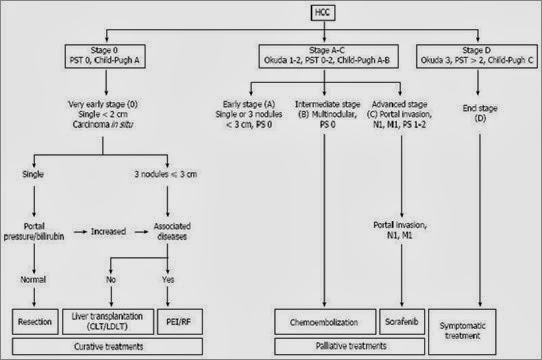
The severity of chronic liver disease is usually classified according to the Child-Pugh and model for end-stage liver disease (MELD) scores, and the tumor is staged with the TNM system; in the setting of liver transplantation, the indication for liver replacement is based mainly on the Milan criteria[17]. Another staging system that has gained acceptance is the Barcelona Clinic Liver Cancer (BCLC) score, the advantage of which is that it takes into account the characteristics of the tumor as well as the liver function and the general conditions of the patient[8] (Figure 2). The BCLC system was developed after a retrospective analysis of several cohort studies on patients with HCC at different stages. This system identifies patients with early HCC who may benefit from curative therapies (stage 0 and A), those at intermediate (stage B) or advanced (stage C) stages who may benefit from palliative treatments and those with a very poor life expectancy (stage D). BCLC is the most commonly used staging system in Europe, and it has been approved by the European Association for the Study of the Liver (EASL) and the AASLD.
WJG-19-7316-g002

Figure 2 The Barcelona Clinic Liver Cancer staging system and treatment allocation. Copyright © 2010, American Association for the Study of Liver Diseases. CLT: Cadaveric liver transplantation; HCC: Hepatocellular carcinoma; LDLT: Living donor liver transplantation; PEI: Percutaneous ethanol injection; RF: Radiofrequency; PST: Performance status.

Multidisciplinary management of HCC

Given the complexity of the clinical scenario, the decision on the most appropriate treatment for a patient with HCC should be made by a multidisciplinary team that includes a hepatologist, hepatobiliary surgeon, transplant surgeon, radiologist and pathologist[18]. No single treatment strategy can be applied to all patients, and treatment should be individualized.

In the management of HCC, attention must be focused on the presence and degree of the underlying chronic liver disease at first observation, which will influence the choice of the treatment[19].

Liver resection can be offered to patients with well-preserved liver function; however, the amount of parenchyma that can be removed in carriers of chronic liver disease is inferior to that which is considered as the safety limit in a normal liver (a “future remnant liver” that is ≥ 30% of the hepatic volume is generally considered acceptable)[19]. Despite a normal liver function, the regenerative potential of a liver that harbors a chronic disease can be surprisingly low.

In cases of impaired liver function, non-surgical procedures or liver transplantation (LT) can be offered; in this setting, the number, size and location of the nodules determine the choice of treatment.

Surgical resection, transplantation and ablation are the treatments that offer the highest rates of complete response and are therefore considered as curative[10]. There are no randomized trials comparing the efficacy of these three approaches, and all evidence is based on the rate of cure reported in different series.

Transarterial chemoembolization (TACE) is the least invasive approach; however, it cannot be considered curative.

Ideally, LT is best treatment for early stage HCC on cirrhosis because it removes both the tumor and the chronic disease that has produced it. However, the application of this powerful tool is limited by the scarcity of donors, which results in strict patient selection criteria to optimize the results.

Candidates for LT for whom a long waiting time (> 6 mo) is predicted may be offered resection, local ablation or transarterial chemoembolization as a ‘bridge’ to transplantation to minimize the risk of tumor progression while they are on the waiting list[20]. The same procedures can also be utilized in attempts downstage tumors that are beyond the eligibility criteria for LT at the time of diagnosis.

Yu et al[21] performed a study on HCC patients who exceeded the University of California San Francisco (UCSF) criteria for LT; these patients were downstaged to fit the UCSF criteria using locoregional therapy and finally underwent LT. Patients who were successfully downstaged prior to transplantation had tumor-free and overall survival rates similar to those observed in patients who met the criteria from the beginning.

A 5-year survival comparable to that of “within criteria” HCC patients can be achieved using LT after successful downstaging. Successful downstaging should include tumor size, number of viable tumors and s-αFP concentrations before and after downstaging. Then, a minimum observation period of 3 mo is recommended before considering LT[22].

If a patient’s hepatic function allows it, liver resection can be offered prior to future transplantation by pursuing two different strategies: first, resection can be used as the primary therapy with LT offered as a rescue therapy should the patient develop tumor recurrence or postoperative liver failure (salvage transplantation); second, resection can be performed on patients with a high risk of tumor progression while awaiting transplantation (bridge to transplantation)[23,24].

SURGICAL RESECTION

When performed in specialized centers, hepatic resection (HR) can be highly effective, with 5-year overall survival rates well above 50% in the major series[25]. Resection is the recommended treatment for patients without advanced fibrosis as long as an R0 resection can be performed with a low risk of postoperative liver failure[14].

The elements that must be taken into account when considering resection of the cirrhotic liver are the Child-Pugh and MELD scores of the underlying liver disease, the degree of portal hypertension and the extension of the parenchymal excision required to obtain a free resection margin.

The aim of HR is to obtain radical resection with limited surgical morbidity; to achieve this goal, patient selection is crucial. For the last several decades, the selection of candidates for resection has been based on Child-Pugh classification. However, Child-Pugh classification is far from accurate for predicting postoperative liver failure; in fact, some Child-Pugh A patients already have liver functional impairment with an increased bilirubin concentration, clinically significant portal hypertension or even minor fluid retention necessitating diuretic treatment[26]. The further investigation of hepatic functional reserve tests, such as the aminopyrine breath test or clearance of indocyanine green (ICG), has been proposed; however, their predictive value remains poorly validated. In Japan, the ICG retention rate is utilized to identify the best candidates for resection[27], whereas portal pressure and bilirubin are the variables used in Europe and the United States[10]. Recently, a preoperative MELD score ≥ 10 was associated with a higher incidence (40%) of postoperative liver failure[28].

Markers of portal hypertension including a porto-caval gradient > 10 mmHg, the presence of esophageal varices, splenomegaly and a platelet count lower than 1× 10¹¹/L are predictors of postoperative morbidity and mortality[29]. In patients without relevant portal hypertension and normal concentrations of bilirubin, the 5-year survival is 70%, whereas this value is 50% for individuals with portal hypertension and is even lower when both these risk factors are present[30,31].

By integrating all of these factors, HR can be safely performed on patients with Child-Pugh class A chronic liver disease, a MELD score ≤ 10, a platelet count > 100.000/mm3 and a porto-caval gradient <10 mmHg. These factors dramatically limit the potential number of candidates, and overall, less than 30% of patients are candidates for HR[29].

After HR, the 5-year survival for cirrhotic patients with HCC ranges from 30% to 50%, whereas the operative mortality ranges from 3% to 8%[29]. The severity of cirrhosis, size of the tumor, number of tumors, presence of vascular tumor invasion and presence of satellite nodules are well-established prognostic factors for recurrence and survival[27,32,33]. Late recurrence is mainly due to the carcinogenic effect of underlying chronic liver disease[34].

Absolute contraindications to HR are the presence of extrahepatic metastases or neoplastic invasion of the main portal trunk. Neoplastic portal vein thrombosis is a poor prognostic factor; however, in highly selected cases, hemi-hepatectomy can be feasible, particularly when thrombosis of a main branch of the portal vein has led to hypertrophy of the contralateral hemiliver.

When compared with open surgery, laparoscopy in cirrhotic patients could have the advantage of avoiding the interruption of collateral abdominal veins that are present as a result of portal hypertension. Several studies have indeed demonstrated the benefits of the laparoscopic approach in terms reduced bleeding and lower postoperative morbidity and mortality[35,36].

LIVER TRANSPLANTATION

HCC is the only solid cancer that can be treated with transplantation. Transplantation is the best curative option for patients with decompensated (Child-Pugh B or C) cirrhosis; however, due to the shortage of donors, it can only be offered to a limited number of patients. Candidates for LT are patients with tumors that have favorable pathological features and therefore a low likelihood of recurrence.

The most widely adopted criteria for selecting HCC carriers for transplantation are the Milan criteria. According to these criteria, LT can be considered only for patients with a single tumor < 5 cm in diameter or for patients with up to 3 tumors < 3 cm without macrovascular invasion[17]. A recent systematic review of 90 studies that followed 17780 patients over a 15-year period identified the Milan criteria as an independent prognostic factor of outcome after LT[37].

Despite recent discussions concerning the restrictive nature of the Milan criteria, these criteria have been adopted by the vast majority of transplant centers. The results of LT in HCC within the Milan criteria are outstanding, with 5-year survival approaching 80%, which is similar to that observed in patients transplanted for benign diseases[30,38,39]. Outside the Milan criteria, survival is significantly reduced, which is likely due to an increased prevalence of variables associated with risk of recurrence, such as microvascular invasion, in tumors at more advanced stages[40].

Neoadjuvant therapy through TACE can occasionally downstage tumors that were outside the Milan criteria at the time of diagnosis; in these cases, the results of LT are similar to those achieved when the criteria were met at first observation[41].

The time spent on the waiting list is a key factor that must be considered when assessing the results of LT in HCC patients; it depends on the availability of donors in a given area and on the system used to prioritize organ allocation. It was demonstrated that 15%-20% of patients with HCC initially within the Milan criteria experience tumor progression until they dropped out from the waiting list; this highlights the need to analyze the results of LT using an intention to treat approach[42]. Although treatments aimed at delaying tumor progression, such as ablation and transarterial chemoembolization, are widely used, their efficacy is unproven[43]. Live donation is a valid strategy for extending the donor pool; however, its applicability is reduced because of societal constraints, scarcity of appropriate donors and the possible morbidity and mortality of donors[44].

Currently, organs are allocated worldwide based on MELD score; however, HCC patients with low MELD scores are given extra points to shorten their waiting time and avoid tumor progression. This policy is questioned by some authors because it might be disadvantageous for patients without HCC[45].

LOCOREGIONAL TREATMENTS

Local ablation techniques have been developed for patients with surgical contraindications and can be performed either through a percutaneous approach or, less commonly, through laparoscopy. These maneuvers include percutaneous ethanol injection (PEI), radiofrequency ablation (RFA), microwave ablation, cryoablation, laser-induced thermotherapy, high-intensity focused ultrasound and irreversible electroporation[46].

The first percutaneous treatment was PEI, which induces coagulative necrosis of the lesion as a result of cellular dehydration, protein denaturation and chemical occlusion of small tumor vessels due to the effects of the injected absolute alcohol. Ablation techniques such as RFA, microwave ablation, and laser ablation utilize high temperatures; conversely, cryoablation causes direct tumor freezing[47].

The evaluation of responses to locoregional treatments and molecular-targeted therapies of HCC is currently based on modified RECIST (mRECIST) criteria, which measure the diameter of the viable tumor component of target lesions[48].

Radiofrequency ablation

RFA is the technique of choice for local destruction of liver tumors. RFA induces coagulative necrosis of the tumor with safety margins around the lesion and is the most commonly used local ablative technique. RFA has largely replaced PEI because it produces better results in terms of recurrence-free survival and requires fewer treatment sessions[49]. RFA can be performed percutaneously under imaging guidance (ultrasound, CT or MRI) or during surgery guided by intraoperative US. The advantage of RF in the treatment of HCC in cirrhotic patients is that it allows selective destruction of the tumor, sparing the surrounding parenchyma, and can be easily repeated in case of recurrence. Complete ablation of lesions smaller than 2 cm is possible in more than 90% of cases[50].

There are several major limits to the use of RF: (1) complete necrosis is rarely observed when the tumor diameter is > 3 cm or when the tumor is adjacent to a major blood vessel due to the cooling effect of the blood flow; (2) it is difficult to reach some areas of the liver parenchyma percutaneously (e.g., segment 1); (3) subcapsular lesions can undergo rupture in the peritoneum; (4) bladder injury can occur when lesions in segments IVb-5 are treated; and (5) targeting the lesion can be difficult under ultrasound guidance in livers with multinodular cirrhosis.

Taking these limitations into account, the benefit of RF in the treatment of HCC has been well demonstrated, with overall 5-year survival rates between 33% and 55% in selected series[51]. The effectiveness of RFA has led to the proposal of this technique as an alternative to HR.

In the only randomized prospective trial with balanced groups of patients comparing HR to RFA for HCC < 3 cm in patients with cirrhosis, no difference was observed in terms of overall and disease-free survival, whereas RF was associated with lower perioperative morbidity (4.2% vs 55.5%, P < 0.05) and mortality (0% vs 1.1%)[52]. However, in a retrospective comparative study of Child-Pugh class A patients, surgery was significantly more effective for patients with single tumors > 3 cm in diameter, with an overall 3-year survival of 66% after surgery (vs 37% after RFA, P = 0.004) and a 3-year disease-free survival of 44% (vs19%, P = 0.001)[53]. This observation was confirmed by subsequent studies performed by different groups[54-56]. A recent systematic review and meta-analysis of 12 controlled trials showed a not notable difference in the short-term effectiveness of RFA and HR in the treatment of early-stage hepatocellular carcinoma meeting Milan criteria, but the long-term efficacy of HR was better than that of RFA[57]. However, HR was associated with more complications and a longer hospital stay.

Rather than competing techniques, RFA and HR are effective therapeutic options that can be chosen based on the severity of chronic liver disease as well as the size and location of the tumor.

Transarterial chemoembolization

Transarterial chemoembolization (TACE) is the most commonly used initial treatment for unresectable HCC[58] and is also the first-line therapy for downstaging tumors that exceed the criteria for transplantation or to avoid tumor progression in patients awaiting LT. TACE may also be considered as a neoadjuvant treatment that can be utilized before HR or RF ablation to reduce tumor volume and possibly target satellite micrometastases[59].

The rationale behind TACE use is the well-characterized angiogenic activity of HCC that results in hypervascular arterial feeding. This technique depends on the intra-arterial infusion of a cytotoxic chemotherapeutic agent emulsioned with Lipiodol followed by embolization of the feeding vessels through a trans-arterial catheter[60]. TACE is a well-established treatment for HCC in cirrhotic patients, and its efficacy for improving survival compared with the other supporting treatments has been demonstrated[61].

The maximum and sustained retention of the chemotherapeutic agent is used as a measure of the success of TACE; thus, embolic microspheres are employed that have the ability to sequester chemotherapeutic agents. The concentration of these microspheres is increased within the tumor, and their contents are subsequently released in a controlled manner over a 1-wk period, which reduces the systemic toxicity to a minimum[62].

Doxorubicin-eluting beads (DEB) are another transarterial liver-directed therapy. The use of an eluting bead can be considered an improvement over conventional TACE. DEB are preformed, deformable microspheres that are loaded with doxorubicin (up to 150 mg per treatment). The pharmacokinetic profile of DEB significantly differs from that of conventional TACE; in particular, the peak drug concentration in the serum is lower for DEB-TACE compared with conventional TACE. An objective response rate of 70% to 80% according to the EASL criteria has been achieved[63]. One- and 3-year survival rates of 89.9% and 66.3%, respectively, have been reported in a heterogeneous cohort of patients with BCLC (stages A to C) treated with DEB-TACE[64].

Absolute contraindications for TACE are decompensated cirrhosis (Child-Pugh B ≥ 8, including jaundice, clinical encephalopathy and refractory ascites), extensive tumor with massive replacement of both lobes in their entirety, severely reduced portal vein flow (portal vein occlusion or hepatofugal blood flow), and a creatinine clearance < 30 mL/min[65].

Microwave ablation

Microwave ablation (MWA) is a potentially curative ablation procedure that has been proven to be safe in both percutaneous and intraoperative settings[66]. MWA can be utilized in patients with advanced liver disease and HCC, provides a more predictable ablation compared with RFA and requires fewer treatment sessions[21,67,68].

Microwave ablation creates an electromagnetic field in the tissues surrounding the ablation antenna with an extension of several centimeter, without flow of electrical current. Tissue within the MWA field heats rapidly to temperatures over 100 °C without the detrimental effects of tissue impedance, allowing a more rapid and consistent ablation[10]. Microwave ablation carries the risk of more severe injury to adjacent structures due to differences in energy delivery when compared with RFA; therefore, the operative approach is preferred over the percutaneous approach because it allows liver mobilization and protection of adjacent organs[66,69,70].

Radioembolization

Radioembolization is a newer hepatic transarterial technique that employs radioactive substances such as Iodine-131-labeled Lipiodol[71] or microspheres containing Yttrium-90[72]. This technique has been shown to be feasible and safe for the treatment of HCC in cirrhotic patients[73,74]. Microspheres are delivered to the tumor area for selective production of high energy and low penetration radiation. Radioembolization can be safely performed in patients with portal vein thrombosis due to the minimally embolic effect of 90Y microspheres[75]. The reported rate of complete tumor necrosis is 90% for patients with HCC < 3 cm[76], whereas the rate of complete necrosis after TACE varies widely in the literature, from 15% to 70%[77].

Radiation therapy

Radiation therapy is generally not considered an option in HCC consensus documents or national guidelines, primarily because of the lack of level 1 evidence[78]. However, experience with conformal radiation therapy (RT), intensity modulated RT, stereotactic body RT and particle therapy is rapidly increasing. RT should be considered as a treatment option in patients unsuitable for other established local therapies[78]. RT has also been used as a bridge to liver transplant and can be safely combined with locoregional therapies such as TACE[78,79].

SYSTEMIC TREATMENTS

Systemic treatment of HCC in cirrhotic patients is not effective due to the poor chemosensitivity of the tumor, and the impairment of hepatic function significantly increases the toxicity of chemotherapy.

Because the demonstrated benefits of systemic chemotherapy and hormonal treatments are lacking[80,81], molecular targeted therapies have recently been developed. Sorafenib, an inhibitor of multi-kinase, has antiproliferative and antiangiogenic activity, delays tumor progression and is currently the only agent with proven efficacy for the treatment of patients with advanced HCC[11,82-84]. This multitargeted tyrosine kinase inhibitor is a small molecule that inhibits vascular endothelial growth factor receptor, platelet-derived growth factor receptor, B-Raf, Fms-related tyrosine kinase and c-kit[85,86].

The use of sorafenib is currently recommended for patients with preserved liver function and advanced HCC who are not suitable for HR or LT and have failed to respond to locoregional treatments[87]. It is recommended that the treatment be continued until progression of the tumor is demonstrated. The main side effects associated with the use of sorafenib are diarrhea and hand-foot skin reaction; other possible side effects include anorexia, nausea, vomiting, weight loss, hoarseness of voice, asthenia and hypertension[52,88]. These effects can occasionally require dose reduction or treatment discontinuation. The potential benefit of sorafenib as adjuvant treatment after LT has not been demonstrated.

On the basis of a large randomized phase III study, the Sorafenib HCC Assessment Randomized Protocol[83], Sorafenib has been approved by the United States Food and Drug Administration for the treatment of patients with advanced HCC.

Studies are ongoing that aim to identify the best responders to Sorafenib; c-Jun N-terminal kinase (JNK) activity was positively correlated with the CD133 expression level and inversely correlated with the therapeutic response to Sorafenib. Accordingly, JNK activity may be considered as a new predictive biomarker for response to Sorafenib treatment[89].

To date, there is no second-line treatment for patients who are intolerant to Sorafenib or experience tumor progression while undergoing treatment.

COMBINED TREATMENTS

A combination of the different therapeutic approaches mentioned thus far is often required to address the different clinical peculiarities of HCC patients. For example, chemoembolization or RFA can be performed before radical surgery with curative intent (HR or LT) to allow effective tumor downstaging or reduce tumor growth. Different authors have proposed HR as a first-line therapy in patients who are candidates for LT[90]; however, the possible effect of previous surgery on the technical complexity of the liver transplantation procedure is a matter of debate[90,91]. One argument in favor of hepatic resection prior to LT is that histological analysis of the tumor can provide useful information regarding its oncological behavior: features such as the presence of a tumor capsule, the degree of differentiation or the presence of micro-vascular invasion can be precisely assessed in the surgical specimen and are well-known prognostic factors. However, there is no consensus among different authors regarding the influence that histological parameters should have on the therapeutic strategy; some authors suggest that LT should be contraindicated for patients with tumors that display poor prognostic histological criteria, whereas others recommend transplant priority in the presence of the same risk factors[23,92].

CONCLUSION

The treatment of HCC in cirrhotic patients has changed significantly over the past several decades and has become a major clinical issue. Patients with HCC on cirrhosis can benefit from several effective treatments that will improve their survival; however, the choice of the most appropriate options depends on several factors, namely: (1) severity of the underlying chronic liver disease; (2) stage of the tumor assessed viaimaging; (3) histological features of the tumor (when available); (4) availability of an active transplant program; (5) availability of a hepatobiliary surgical unit; and (6) availability of an experienced interventional radiology service.

Some of these variables may account for the different attitudes that are often observed. To ensure that the most effective treatment can be offered for a given case, a multidisciplinary approach is warranted, and professionals skilled in the administration of the different treatment types should be available. The increase in the incidence of HCC justifies the development of services related to the management of this tumor.

Footnotes

P- Reviewer: Scherubl H S- Editor: Gou SX L- Editor: A E- Editor: Zhang DN

References

Source